Books That Connect Us with Nature and the Soul | Inspiration

Updated: Aug 4
In an increasingly fast-paced and digital world, books that connect us with nature, soul, and perception become anchors. They bring us back into a living relationship with the world. This article brings together a curated selection of books that accompany and inspire the philosophy, language, and practice of Olivia, founder of Kailo Nature Therapy.
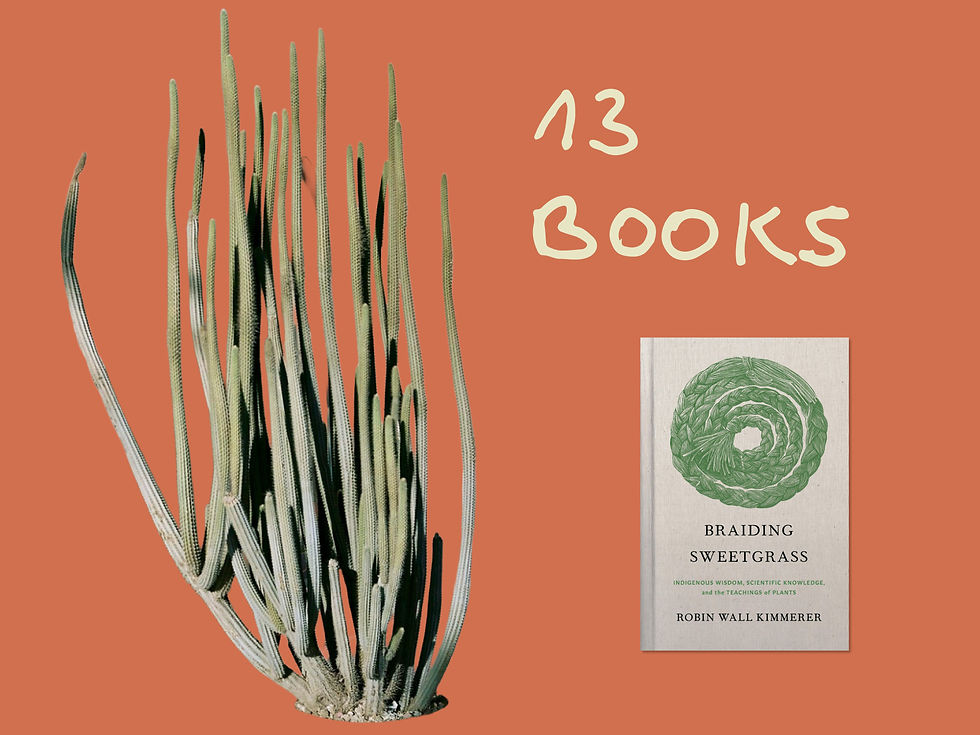
Here you will find my selection of books on nature connection, landscape perception, bodywork, and the depths of psychology, featuring authors such as David Abram, Mary Oliver, Robin Wall Kimmerer, Elif Shafak, Delia Owens, and C.G. Jung. Each book is presented through its central idea and the inspiration it offers for encounters with nature and with oneself.
Books can be like landscapes. Some lead us outward – into forests, deserts, to rivers. Others lead us inward – into images, memories, archetypal spaces.
If you are interested in connecting with nature or are looking for books that draw you equally into the landscapes of the soul and the outer world, this list offers a first orientation – and invites you to delve deeper into the individual themes.
Books by Theme
Nature Connection
# David Abram: The Spell of the Sensuous. Perception and Language in a More-Than-Human World (1997)

Essence:
David Abram shows that our estrangement from nature arises from a sensory perception we have unlearned, and that through the body we can return to a direct, reciprocal relationship with the “more-than-human world.” For him, perception does not mean observing, but participating: touching and being touched, speaking and being addressed. From this emerges an embodied, feeling form of ecology.
What touches us: This book changes how we listen, see and move through landscapes. It opens up a new way of perceiving and reveals our being as a living membrane in relationship with all that is alive:
“When I touch the furrowed skin of a tree, I always experience my own capacity to be touched and feel myself being touched by the tree. We can perceive things only because we ourselves are wholly part of the perceptive, sensuous world!”
Keywords: Perception · Sensuousness · Philosophy of nature · Connection
Author: Dr David Abram is a philosopher, anthropologist and cultural ecologist. He has conducted research and worked in a variety of cultural contexts, exploring perception, language and the living relationship between humans and nature. His work has profoundly shaped the discussion around the more-than-human world.
# Robin Wall Kimmerer: Braiding Sweetgrass. Indigenous Wisdom, Scientific Knowledge and the Teachings of Plants (2020)

Essence: Through stories of sweetgrass, strawberries, water lilies and the “Three Sisters” — corn, beans and squash — Kimmerer makes tangible how a respectful relationship with the Earth is rooted in reciprocity. She weaves Indigenous wisdom together with the scientific study of plant ecology. Her central message: a deeper ecological awareness emerges when we learn to recognise the generosity of the Earth and to offer something in return.
“A more comprehensive ecological awareness requires us to recognise and value our reciprocal relationship with the living world. Only when we begin to hear the languages of other beings can we understand the generosity of the Earth and learn to offer our own gifts in return.”
What touches us:
Nature connection does not begin with knowledge, but with relationship. We are particularly moved by her understanding of plants as teachers. Her stories allow us to feel that nature does not only sustain us, but can continually teach us something about community, care, transformation and connection — when we are willing to listen.
Keywords:
Reciprocity · Plant knowledge · Indigenous wisdom · Gratitude · Ecological connection
Author:
Robin Wall Kimmerer is a botanist, professor of plant ecology and a member of the Citizen Potawatomi Nation. In her work, she brings together scientific research and Indigenous knowledge, creating a bridge between two ways of understanding that were long regarded as opposites.
# Mary Oliver: Devotions: The Selected Poems of Mary Oliver (2017)

Essence:
Devotions brings together poems from more than five decades of Mary Oliver’s work. In clear, quiet language, she writes about forests, animals, water, love and impermanence. Her close observation of nature repeatedly leads to essential questions: How do we want to live? What does it mean to pay attention and experience ourselves as part of this world?
“Tell me, what is it you plan to do
with your one wild and precious life?”
What touches us:
Mary Oliver makes the ordinary meaningful. A bird, a pond or the morning light becomes an invitation to slow down and look more closely. Her poems remind us that wonder, grief and beauty can exist side by side.
Keywords:
Nature poetry · Attention · Wonder · Impermanence · Belonging
Author:
Mary Oliver (1935–2019) was an American poet. Her accessible, nature-centred poems received major literary honours, including the Pulitzer Prize and the National Book Award.
Landscape, Place & Perception
# Stefan Brönnle: Landschaften der Seele. Von mystischen Orten, heiligen Stätten und uralten Kulten (1998; only available in German)

Essence:
Stefan Brönnle shows that inner and outer landscapes are inseparably connected: how we live, feel and think is directly linked to the spaces that surround us. Places carry qualities, atmospheres and information that we can perceive when we open our sensitivity to them. Through numerous examples, the book shows how cultures, religions, history and architecture become tangible in the idea of landscapes of the soul. It explores how the forms of landscapes, the direction of a river, and the nature and arrangement of plants shape inner attitudes, religious beliefs and ways of life.
What touches us:
The clear and logical writing style, accessible to everyone, invites us to open our eyes wide and sense how closely our minds are connected with nature. This bond brings us into harmony with ourselves. Reading this book opens our awareness to the fact that the sacred is not far away, but can be found within landscapes, and that mystical places can also be discovered close to home.
Keywords: Landscape awareness · Geomancy · Culture & nature · Sacred places
Author:
Dipl.-Ing. Stefan Brönnle is a geomancer, landscape ecologist, author and researcher whose work explores the interplay between human beings, consciousness and landscape, translating these connections into practical experience. He also works as a geomantic consultant and designer, lecturer and director of training programmes in geomancy.
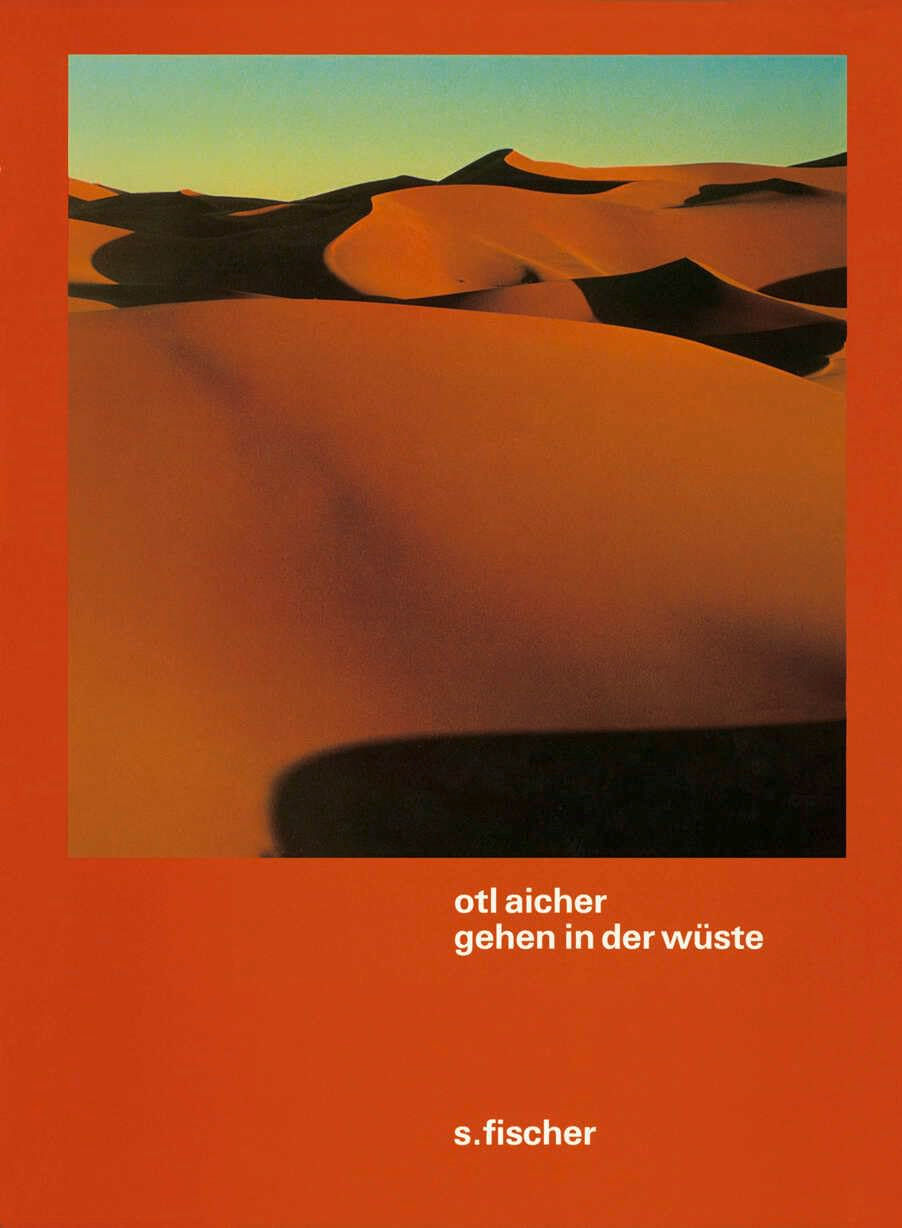
# Otl Aicher: gehen in der wüste (1982/2005; only available in German)
Essence:
Otl Aicher’s book is an interplay of photography, typography and fragmentary texts, created from his walks through the Sahara. The starkness of the desert and walking as a mental process open up a space for clarity and perception – the landscape becomes a landscape of thought.
The book also follows this approach in its form: consistently set in lowercase, it shifts the focus away from the object and towards the process, the act of doing, the experience of being on the way. The result is a work that lies somewhere between a photographic book, a philosophical essay and a typographic artwork.
“the desert is a landscape of thought. one does not only walk among dunes, one also wanders through one’s own thinking, one follows trains of thought. as one walks, the landscape changes from image to image. the horizon of thought changes too. the eye is drawn here, then there, and thoughts roam freely as well. one casts them outward, as drafts.”
What touches us:
A total work of art. The mere sensation of the coarse, sand-coloured linen cover makes us want to immerse ourselves in this book – to linger over the photographs and absorb the texts.
It is not a book that asks to be read linearly, but a space in which to pause, browse and discover. Like a journey into the interior of a free and lucid mind.
Keywords: Walking · Reduction · Desert · Movement · Thought · Landscape · Simplicity
Author:
Otl Aicher was one of the most influential communication designers of the twentieth century. Beyond his work for the 1972 Olympic Games, his oeuvre stands for clarity, reduction and a profound understanding of design as an expression of attitude and thought.
Body, Ritual & Expression
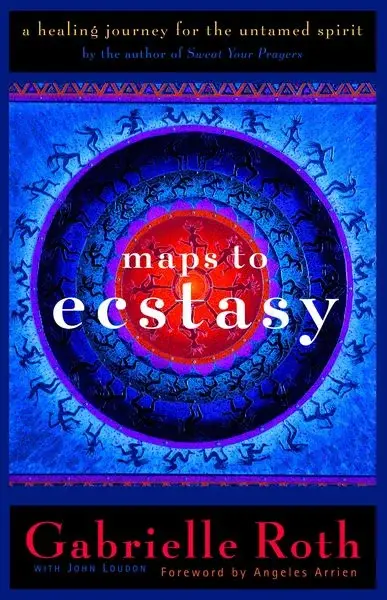
# Gabrielle Roth: Maps to Ecstasy. The Healing Power of Movement (1998)
Essence:
Gabrielle Roth describes the body as a direct gateway to the inner world. Rather than analysing emotions and life experiences solely through the mind, the founder of the internationally renowned 5Rhythms movement meditation invites us to explore and express them through movement.
At the heart of her work are the “5Rhythms” – Flowing, Staccato, Chaos, Lyrical and Stillness – which she understands as natural movement patterns of human energy. Dance is not treated as performance, but as a practice of perception. Movement helps us to let go of the mind for a moment, bring held emotions back into flow and reconnect with our own inner centre.
“Move the body and the psyche will follow.”
What touches us:
Some experiences need to be felt, moved and embodied.
What touches us most is Roth’s understanding of the body as a living map of our feelings, stories and potential. Her work invites us to see movement not as something external, but as a language of the soul – and as a path towards bringing greater vitality, expression and presence into our lives.
If you’d like to explore Gabrielle Roth’s healing movement practice and the 5Rhythms more deeply, you can also read our article on Healing Movement | Gabrielle Roth.
Keywords:
Embodiment · Dance · Rituals · Emotions · Expression · 5Rhythms
Author:
Gabrielle Roth (1941–2012) was a dancer, musician and the founder of the internationally renowned movement meditation known as “The 5Rhythms.” Through her work with people from a wide range of backgrounds, she developed a practice that brings together dance, psychology, ritual and spiritual experience. Her work continues to shape the international embodiment and conscious dance movement today.
# Susanne Fischer-Rizzi: Mit der Wildnis verbunden (2007/2023; only available in German)

Essence:
This book brings together wilderness knowledge, nature observation, plant lore and ancient traditions, offering a practical invitation to deepen our relationship with nature step by step. Across twelve themes – from the language of birds, tracking and fire to trees, plants and our own senses – Fischer-Rizzi opens up tangible pathways into the natural world. The focus is not primarily on acquiring knowledge, but on remembering a connection that already lives within each of us.
What touches us:
Nature connection does not arise only in extraordinary moments, but through attention, presence and spending time outdoors regularly. The book offers many small practices that act like doorways back into relationship with nature. Rather than giving the impression that we need to learn something entirely new, the author reminds us of something deeply familiar.
“The more often we spend time in this ‘secret’ place, the more we begin to understand the relationships within the surrounding natural world. We feel connected to it.”
Keywords:
Wilderness knowledge · Nature observation · Plant knowledge · Senses · Wilderness culture
Author:
Susanne Fischer-Rizzi is regarded as one of the pioneers of wilderness culture and medicinal plant knowledge in the German-speaking world. Over several decades, she learned from herbalists, Indigenous traditions and nature mentors in Europe, North America, India and Tibet. Through her books and her school, ARVEN, she has long contributed to preserving ancient nature knowledge and passing on a living relationship with the Earth.
Archetypes, Psyche & Inner Patterns
# C.G. Jung: Man and His Symbols (1964)

Essence:
This work is C. G. Jung’s own contribution to understanding the unconscious and, at the same time, his legacy. It offers an accessible path into the deeper layers of the human psyche. Through dreams, symbols and archetypal images, he shows that the unconscious is constantly communicating with us – not through words, but through images, metaphors and stories.
This extensive book provides an overview of approaches to the unconscious, the function of dreams, archetypes in dream symbolism, the figure of the hero, eternal symbols and the relationship of modern human beings to myth.
What touches us:
This book reminds us that much of what moves us cannot be understood through reason alone. It opens our eyes to the hidden forces, patterns and images that shape our lives, often without our conscious awareness. While reading, a sense emerges that these are not random, but part of a larger context that connects us more deeply with ourselves.
Keywords:
Symbols · Dreams · Archetypes · The unconscious · Individuation · Self-development
Author:
Carl Gustav Jung was a psychiatrist, psychologist and the founder of Analytical Psychology. Through his research into archetypes, dreams, myths and the collective unconscious, he had a lasting influence on our understanding of the human psyche. His work continues to shape psychology, philosophy, art and spirituality today.
# Michael Conforti: Field, Form, and Fate: Patterns in Mind, Nature, & Psyche (1999)

Essence:
In Field, Form & Fate, Michael Conforti explores the invisible patterns that shape both natural processes and human behaviour. Drawing on C. G. Jung’s theory of archetypes, he describes how the same formative principles can be seen in the flight paths of migratory birds, the growth of a fungus, interpersonal relationships and recurring patterns in our lives. Rather than understanding fate as something random, Conforti views it as the expression of deeper fields that influence our behaviour, relationships and decisions. The book’s central question is: Which patterns are working through us, and how can we learn to perceive them consciously?
What touches us:
This book changes the way we look at repetition in our lives. Why do people repeatedly find themselves in similar relationships? Why do certain themes or dynamics return again and again? Situations, conflicts and turning points no longer appear as isolated events, but as expressions of a deeper order that continually reveals itself.
Keywords:
Archetypes · Fate · Pattern recognition · Fields · Synchronicity · Analytical Psychology
Author:
Dr Michael Conforti is a Jungian analyst, author and founder of the Assisi Institute. For decades, he has researched archetypal fields, synchronicity and the hidden patterns that shape individual and collective life. His work brings together C. G. Jung’s depth psychology with a precise observation of recurring structures in nature, culture and human development.
Nature Therapy, Resonance & Practice
# Astrid Habiba Kreszmeier: Natur-Dialoge. Der sympoietische Ansatz in Therapie, Beratung und Pädagogik (2021) & Systemische Naturtherapie (2018) [only available in German]

Essence:
In her two books Systemic Nature Therapy and Nature Dialogues, Astrid Habiba Kreszmeier describes a form of therapy, counselling and guidance that does not view human beings as separate from their environment. Through the concept of Nature Dialogues, Kreszmeier expands systemic practice by asking how we can enter into resonance with the more-than-human world. Nature becomes a partner in dialogue: a tree, a path, a river or a change in the weather can become just as much a part of a process of insight as words or relationships.
Kreszmeier invites us to “think from the Earth and towards the Earth” and to understand the world as a web of reciprocal relationships.
“Nothing happens without the place in which we find ourselves.”
What touches us:
Habiba’s books form part of the foundation of Kailo Nature Therapy and Olivia’s therapeutic work. They remind us that transformation is always a relational process – involving other people, places, landscapes and the Earth itself. One concept that stands out in particular is that of a culture of resonance. It describes an attitude in which perception, care, cooperation and connection become essential resources.
Keywords:
Systemic Nature Therapy · Resonance · Nature coaching · Relationship · Sympoiesis · More-than-human world
Author:
Astrid Habiba Kreszmeier is a nature therapist, supervisor, trainer and co-founder of Systemic Nature Therapy and the Sympoi Institute. For decades, she has combined systemic thinking with nature experience, process-oriented work and ecological awareness. Her work has played a significant role in shaping the development of nature-based therapeutic approaches and continues to inspire people working in therapy, education, coaching and community practice.
👉🏼 View & purchase the book (Natur Dialoge)
👉🏼 View & purchase the book (Systemische Naturtherapie)
Stories That Connect
# Delia Owens: Where the Crawdads Sing (2018)

Essence:
The novel tells the story of Kya, who grows up in isolation in the marshlands and comes to understand the world through her direct relationship with nature. She knows every stone and every seabird, every shell and every plant. As she slowly opens herself to human closeness, the fragility of this balance becomes apparent, with dramatic consequences. Particularly striking is the way the book intertwines the experience of nature, loneliness, vulnerability and the process of becoming oneself.
What touches us:
This book allows us to feel how deeply we are shaped by where we come from, and how closely beauty, mystery and violence coexist in nature. Owens’ scientific precision, narrative sensitivity and vivid descriptions of the landscape draw us deeply into a world in which loneliness and connection exist side by side.
Keywords:
Nature · Loneliness · Belonging · Emotion · Connection · Drama
Author:
Delia Owens is a zoologist and author who spent many years researching wildlife in remote regions of Africa. Her close, often existential relationship with nature – shaped by observation, silence and life in wild landscapes – is deeply present in her writing.
# Elif Shafak: The Island of Missing Trees (2021)

Essence:
A fig tree becomes the guardian of memories. It tells of love and war, displacement and home, the wounds of a family and the scars of an island. Elif Shafak weaves together human and more-than-human stories in a novel about the love between Defne, a Turkish woman, and Kostas, a Greek man, set against the backdrop of the civil war in Cyprus. Decades later, their daughter Ada tries to understand the fragments of her family history in London.
“Ultimately, we remember for the same reasons we would prefer to forget – in order to survive in a world that neither understands nor values us.”
What touches us:
Stories do not live on only in people; they are also held within landscapes, plants and places. The fig tree becomes a silent witness to love, war, separation and hope, carrying memories across borders, generations and cultures.
Equally moving is the question of how trauma and loss are passed on – and how connection can nevertheless endure.
If you’d like to discover what the fig tree in the book has to say about us humans, you can also read our article in the Kailo Journal.
Keywords:
Memory · Belonging · Migration · Family history · Fig tree · Nature & identity
Author:
Elif Shafak is one of Europe’s most significant contemporary storytellers. The British-Turkish author brings together themes such as identity, memory, culture, spirituality and social change in her novels. Her stories cross national borders and open up new perspectives on the ways in which people, places and stories coexist.
Connect with your outer and inner nature at one of my events and retreats or dive deeper in a 1:1 guidance.